Where Will the Next FIFA World Cups Be Held? 2030 and 2034 Host Guide
Where Will the Next FIFA World Cups Be Held? 2030 and 2034 Host Guide: Looking Beyond the FIFA World Cup 2026
The Evolution of Global Football: Transitioning from the FIFA World Cup 2026
The global sports industry has entered an era of rapid expansion, demanding more dynamic, inclusive, and expansive formats. With the expansion to 48 teams debuting at the FIFA World Cup 2026, the traditional single-nation hosting model has become increasingly difficult to maintain due to massive structural demands. Therefore, the co-hosting framework popularized by the FIFA World Cup 2026 has become the new industry gold standard.
In addition, hosting a tournament of this magnitude requires advanced transportation systems, immense hospitality capacities, and state-of-the-art sporting venues. Consequently, governing bodies must look beyond borders to distribute the financial and logistical burdens. As we look toward the 2030 and 2034 tournaments, the strategies tested in the late 2020s will serve as critical reference points.
Understanding the Multi-Nation Hosting Model of the FIFA World Cup 2026
To understand the complexity of future bids, one must first look at the blueprint established by the FIFA World Cup 2026. Coordinating a tournament across sixteen distinct host cities is an achievement that requires unprecedented administrative harmony. For fans, players, and officials, traversing three sovereign nations introduces complex legal, economic, and operational challenges.
Across the United States, Mexico, and Canada, the organizers of the FIFA World Cup 2026 had to coordinate complex cross-border logistics, unified transportation, and joint security protocols. This collaborative governance model ensures that no single country is overwhelmed by the sheer volume of visitors. Furthermore, this distribution of matches allows a larger variety of communities to experience the cultural phenomenon of live tournament matches first-hand.
How the FIFA World Cup 2026 Set a New Standard for Stadium Capacity
For instance, the stadiums selected for the FIFA World Cup 2026 represent some of the most advanced sporting arenas in the world. From iconic traditional venues to ultra-modern dome facilities, these environments are designed to optimize the spectator experience. The inclusion of high-capacity arenas ensures record-breaking attendance and robust ticket revenue.
Consequently, the lessons learned from the stadium upgrades of the FIFA World Cup 2026 will directly influence future engineering projects. Stadiums are no longer viewed merely as playing fields; instead, they are multi-functional entertainment complexes designed with long-term urban integration in mind. This sustainable approach is a core requirement for any nation wishing to secure hosting rights in the future.
The 2030 FIFA World Cup: A Centenary Celebration Across Three Continents
In 2030, the global tournament will celebrate a historic milestone: its 100th anniversary. To honor the centennial legacy of the very first tournament held in Uruguay in 1930, FIFA announced a truly unique hosting arrangement. This edition will transcend traditional boundaries, uniting three distinct continents and six sovereign nations in a shared celebration of football history.
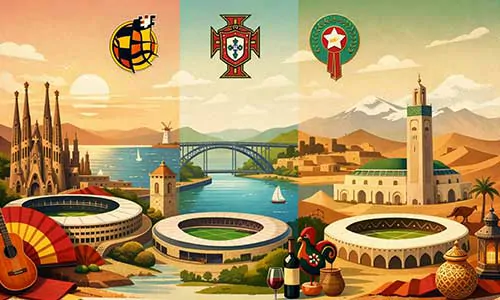
The primary co-hosts for the 2030 tournament will be Morocco, Portugal, and Spain. Meanwhile, the South American nations of Uruguay, Argentina, and Paraguay will host special centenary celebration matches to open the tournament. This multi-continental structure represents the ultimate evolution of the sport’s global footprint.
Morocco’s inclusion is particularly historic, marking only the second time an African nation has hosted World Cup matches. The country is investing heavily in state-of-the-art facilities, including the construction of the massive Hassan II Stadium in Benslimane, near Casablanca, which is designed to hold over 115,000 spectators. On the European side, Spain’s legendary venues like the newly renovated Santiago Bernabéu and Camp Nou, alongside Portugal’s elite arenas in Lisbon and Porto, will provide a world-class foundation for the tournament’s latter stages.
How the FIFA World Cup 2026 Paved the Way for 2030’s Intercontinental Bid
Without the logistical data gathered during the planning of the FIFA World Cup 2026, a multi-continental tournament would have been viewed as an operational impossibility. Managing time zones, long-distance flights, and diverse climate conditions requires an intricate understanding of elite athletic recovery. The strategic scheduling frameworks developed for North America will directly inform the scheduling of 2030.
Furthermore, while the FIFA World Cup 2026 unites three nations in one continent, the 2030 iteration will span six countries across Africa, Europe, and South America. This staggering geographic scope demonstrates how globalized the sport has become. It challenges organizers to create a seamless experience for traveling supporters, ensuring that visa regulations, currency exchanges, and transit networks are optimized for millions of international visitors.
The 2034 FIFA World Cup: Saudi Arabia’s Bold Vision
Looking even further into the future, the 2034 edition of the tournament is set to make a historic return to the Middle East. Following a comprehensive and uncontested bidding process confirmed in late 2024, Saudi Arabia was officially designated as the host nation. This decision aligns with the nation’s broader “Vision 2030” initiative, which seeks to diversify its economy and establish the Kingdom as a global hub for tourism, culture, and elite sports.
Saudi Arabia’s hosting plan is incredibly ambitious, focusing on five primary host cities: Riyadh, Jeddah, Al Khobar, Abha, and the newly developed, futuristic city of NEOM. The infrastructure plans involve constructing several architecturally striking stadiums, including a venue located 350 meters above the ground within the smart-city development of “The Line” in NEOM.
Similar to the massive infrastructural preparation seen in the FIFA World Cup 2026, Saudi Arabia is committing billions of dollars to build world-class training facilities, expand transit networks, and construct high-capacity hotels. Because of the extreme summer temperatures in the region, discussions are ongoing regarding the exact timing of the tournament, with many analysts expecting a shift to a cooler winter schedule, similar to the 2022 tournament in Qatar.
Comparing the Infrastructure of Saudi Arabia 2034 with the FIFA World Cup 2026
In addition, Saudi Arabia is planning an unprecedented technological leap, seeking to match and even exceed the high-tech standards set by the FIFA World Cup 2026. While North America relies heavily on existing major NFL and MLS stadiums, the Kingdom of Saudi Arabia is designing dedicated football-first venues equipped with cutting-edge cooling systems and revolutionary spectator interfaces.
On the other hand, while the FIFA World Cup 2026 leverages decades-old iconic venues that carry immense historical value, Saudi Arabia is building entire cities and futuristic arenas from scratch. This approach presents a fascinating contrast in sports architecture. One model showcases retrofitted, high-capacity multi-sport coloseums, while the other presents a clean-slate vision of the future of sports entertainment.
Key Tactical Lessons Inherited from the FIFA World Cup 2026
Ultimately, the football universe is witnessing a golden age of structural expansion, all catalyzed by the blueprint of the FIFA World Cup 2026. From managing 48 teams to mastering complex multi-national logistics, future hosts have a wealth of data to study. By analyzing crowd flow, team base camps, and international broadcast requirements, future organizers can minimize operational risks.
Therefore, as we transition from the immediate excitement of North America’s stadiums to the multi-continental celebrations of 2030 and the futuristic landscapes of Saudi Arabia in 2034, one thing remains certain: the tournament continues to push the absolute limits of human ambition and international cooperation.
Comprehensive Hosting Comparison Matrix
The following table provides a quick, structured comparison of the upcoming editions of the tournament, detailing key features, hosting structures, and scope:
| Tournament Edition | Host Nations | Number of Teams | Continents Involved | Key Structural Feature |
|---|---|---|---|---|
| FIFA World Cup 2026 | United States, Canada, Mexico | 48 Teams | North America | First edition to feature 48 teams; spanning three nations. |
| FIFA World Cup 2030 | Morocco, Portugal, Spain (Primary) Uruguay, Argentina, Paraguay (Centenary matches) |
48 Teams | Africa, Europe, South America | Centenary celebration; spanning three continents and six nations. |
| FIFA World Cup 2034 | Saudi Arabia | 48 Teams | Asia | Futuristic, single-nation hosting model with specialized climate-controlled stadiums. |
Frequently Asked Questions (FAQ)
1. Which countries will host the 2030 FIFA World Cup?
The 2030 tournament will be primarily hosted by Morocco, Portugal, and Spain. Additionally, to celebrate the 100-year centenary of the tournament, the opening three matches will be played in Uruguay, Argentina, and Paraguay.
2. Why are matches being played in South America for the 2030 World Cup?
Uruguay hosted and won the inaugural tournament in 1930. To commemorate the 100th anniversary of this historic event, Uruguay, Argentina, and Paraguay will each host one celebratory opening match before the rest of the tournament shifts to Morocco, Portugal, and Spain.
3. Who is hosting the 2034 FIFA World Cup?
Saudi Arabia is the officially confirmed host nation for the 2034 edition, which follows the expanded format introduced in the FIFA World Cup 2026. The bid was formally approved by FIFA in December 2024.
4. How many teams will participate in the 2030 and 2034 tournaments?
Both the 2030 and 2034 tournaments will feature 48 teams. The expanded 48-team format debuting in the FIFA World Cup 2026 will carry over as the permanent structure for future tournaments, allowing more nations from every continent to qualify.
5. Will the 2034 World Cup in Saudi Arabia be played in the summer?
Due to the extremely high summer temperatures in Saudi Arabia, it is highly anticipated that the tournament will be scheduled during the cooler winter months (similar to Qatar 2022) to protect the health of the players and provide a comfortable environment for fans.
6. Where can I find official hosting announcements and updates?
All official announcements, bidding evaluation documents, stadium specifications, and ticket details are published directly on the Official FIFA Website.
Conclusion & Global Football Outlook
The future of international football is expanding in ways never previously imagined. From the historic kickoff of the FIFA World Cup 2026 to the high-tech arenas of Saudi Arabia in 2034, the tournament’s evolution is unstoppable. These tournaments do more than determine the best footballing nation on the planet; they act as a catalyst for massive cultural exchange, technological integration, and unparalleled global unity.
To discover more historical data about the rotation of tournament hosts, you can explore Wikipedia’s complete list of FIFA World Cup hosts.
What are your thoughts on the multi-continental 2030 model or Saudi Arabia’s futuristic stadium plans? Share your thoughts in the comments below, and don’t forget to bookmark this page to stay updated on future international football tournaments!