Offside Rule Explained: A Beginner’s Guide to Football’s Most Confusing Law
Offside Rule Explained: A Beginner’s Guide to Football’s Most Confusing Law Ahead of the FIFA World Cup 2026
The beautiful game is famous worldwide for its sheer passion, fast-paced action, and relative simplicity. Two teams, one pitch, and one goal: to put the ball in the back of the net. Yet, there is one rule that consistently sparks endless debates in pubs, stadiums, and television studios. That rule is Law 11 of the game, better known as the offside rule.
With the highly anticipated FIFA World Cup 2026 just around the corner, millions of new fans are preparing to immerse themselves in the sport. Understanding this fundamental rule is your gateway to appreciating the match dynamics without feeling lost during critical refereeing decisions. Furthermore, knowing how offside works will completely transform how you view team strategies.
In addition, the rule is not as complex as it initially seems once you break it down into simple concepts. This guide is designed to clarify the rule’s foundations, show you its exceptions, and prepare you to watch the upcoming tournament like a seasoned expert.
Table of Contents
- 1. What is the Offside Rule? The Absolute Basics
- 2. Why the Offside Rule Matters for the FIFA World Cup 2026
- 3. The Three Conditions of an Offside Position
- 4. Offside Position vs. Offside Offence: The Crucial Difference
- 5. What Triggers an Offside Offence? (Active Play)
- 6. How Technology at the FIFA World Cup 2026 Redefines Offside Decisions
- 7. Common Offside Misconceptions Before the FIFA World Cup 2026 Kicks Off
- 8. The Three Absolute Exceptions to the Rule
- 9. The Offside Trap: Tactical Masterclass or Huge Risk?
- 10. Preparing for the FIFA World Cup 2026: Tips for New Fans
- 11. Conclusion & Matchday Challenge
- 12. Frequently Asked Questions (FAQ)
1. What is the Offside Rule? The Absolute Basics
At its heart, the offside rule prevents attacking players from “cherry-picking” or “goal-hanging.” Without this law, strikers could simply stand next to the opponent’s goalkeeper and wait for a long, high pass from across the pitch to score an easy goal.
Consequently, the game would become disjointed, boring, and stripped of the tactical buildup that makes football so thrilling. Therefore, the rule serves to keep the game balanced, demanding that teams use clever passing, speed, and creative positioning to break down defensive blocks.
Historically, the rule has evolved significantly to encourage high-scoring matches. Under the current rules, governed by the International Football Association Board (IFAB), a player must time their run perfectly to ensure they are onside when their teammate passes the ball forward.
2. Why the Offside Rule Matters for the FIFA World Cup 2026
Tactical setups at the FIFA World Cup 2026 will rely heavily on structured defensive lines and rapid counter-attacks. Modern coaches utilize high defensive lines to compress the playing space, meaning defenders often push far up the field, leaving massive space behind them.
Meanwhile, attackers look to exploit this space by sprinting behind the defense at the precise fraction of a second. Consequently, offside calls will determine the outcome of massive, high-stakes matches in this global tournament. A single inch can be the difference between a historic winning goal and a disallowed effort.
For viewers, tracking how teams manage the offside boundary offers a fascinating look into the chess match played by elite managers. When you understand this mechanic, you can easily appreciate why certain teams drop deep or why others press high up the pitch.
3. The Three Conditions of an Offside Position
Every manager preparing for the FIFA World Cup 2026 spends countless hours teaching their players how to manage their body positions. To understand where a player can stand legally, we must first look at what defines an “offside position.”
A player is considered to be in an offside position if they meet three specific criteria at the same time:
- The Opponent’s Half: The player must be in the opponent’s half of the field. You can never be offside if you are standing in your own half.
- Ahead of the Ball: The player must be closer to the opponent’s goal line than the ball itself.
- The Second-Last Opponent: The player must be closer to the opponent’s goal line than the second-last defending opponent. In almost all normal scenarios, the goalkeeper is the last opponent, which means there must be at least one outfield defender between the attacker and the goal.
Importantly, only the parts of the body that can legally score a goal are considered when determining these boundaries. This includes the head, torso, and legs. On the other hand, the hands and arms of players are completely ignored because they cannot legally contact the ball during play.
4. Offside Position vs. Offside Offence: The Crucial Difference
It is incredibly important to note that being in an offside position is not an offence in itself. An attacker can stand right next to the goalkeeper in an offside position all day, and the referee will not blow the whistle.
The infraction only occurs the exact moment a teammate touches or plays the ball, and the offside player becomes actively involved in the play. If the ball is passed elsewhere, or if the offside player remains completely inactive, play continues without any interruption.
Making this distinction is critical for the officials working the matches of the FIFA World Cup 2026. Assistant referees are taught to wait and see how the play unfolds before raising their flags, ensuring they do not stop play prematurely when an offside position does not translate into an active offence.
| Scenario Details | Offside Position | Offside Offence |
|---|---|---|
| Is the Whistle Blown? | No | Yes |
| Main Requirements | Standing past the second-last defender in the opponent’s half. | Becoming actively involved in the play when a teammate passes the ball. |
| Restart of Play | Play continues uninterrupted. | Indirect free kick awarded to the defending team. |
5. What Triggers an Offside Offence? (Active Play)
To fully understand when the referee will whistle for an infraction, we must explore what “active involvement” means. According to the official IFAB rulebook, there are three main ways an offside position turns into an active offence:
A. Interfering with Play
This is the most straightforward trigger. It occurs when a player simply plays or touches the ball that was passed or touched by a teammate. If an attacker in an offside position receives a direct pass and controls it, the linesman will immediately raise their flag.
B. Interfering with an Opponent
A player can be penalized even if they do not touch the ball. If their physical presence prevents an opponent from playing the ball, they are interfering. This includes blocking the goalkeeper’s line of sight, challenging a defender physically for the ball, or clearly moving to distract a nearby opponent.
C. Gaining an Advantage
If the ball rebounds off the goalpost, crossbar, or an opposing player, and lands directly at the feet of an attacker who was standing in an offside position when the shot was originally taken, they are penalized. They have gained an unfair advantage by being in that prohibited area initially.
6. How Technology at the FIFA World Cup 2026 Redefines Offside Decisions
In the past, assistant referees had to rely strictly on their eyes to judge offside situations, often leading to human error. However, the implementation of semi-automated offside technology at the FIFA World Cup 2026 ensures unprecedented accuracy and transparency in decision-making.
This state-of-the-art system operates using a network of tracking cameras installed around the stadium’s roof. These cameras track up to 29 individual data points on each player’s body, 50 times per second, calculating their exact position on the pitch in real-time.
In addition, the official match balls are embedded with an inertial measurement unit (IMU) sensor. This sensor sends ball data to the video operation room 500 times per second, detecting the precise millisecond the ball is kicked or touched.
When an attacker in an offside position receives the ball, the system automatically alerts the Video Assistant Referee (VAR) crew. After checking the kick point manually, the VAR confirms the decision to the on-field referee, keeping delays to a absolute minimum.
Furthermore, fans watching the FIFA World Cup 2026 will see 3D visual renders of tight offside calls on television broadcasts and stadium screens. This visual representation leaves no room for doubt, showing exactly how far an attacker’s limb was past the line.
7. Common Offside Misconceptions Before the FIFA World Cup 2026 Kicks Off
Because the rule contains multiple layers, several myths have developed over the years. Spectators of the FIFA World Cup 2026 will likely hear debates about the “second-last opponent” during close calls. Let us clear up the most common misconceptions:
The Goalkeeper Myth
Most fans think of the offside line as being tied to the last defending outfield player. However, the official rule states “second-last opponent”. If the goalkeeper rushes far out of their goal to clear a ball, they are no longer the last opponent. In this rare scenario, there must be two defending outfield players between the attacker and the goal line for the attacker to remain onside.
The Halfway Line Rule
A player can never be offside if they are still on their side of the pitch when the ball is kicked. Even if the entire opposing team is in your half, as long as you start your sprint from your own half, you are completely safe from being penalized.
The Direction of the Pass
Many beginners believe that a backward pass can never result in an offside call. In reality, the direction of the pass does not matter; what matters is the position of the receiver. If an attacker is ahead of the ball and ahead of the second-last defender when a backward pass is made, they are still offside. On the other hand, if they are behind the line of the ball when it is played, they can receive any pass legally.
8. The Three Absolute Exceptions to the Rule
When matches of the FIFA World Cup 2026 get underway, you will notice teams exploiting specific situations where the offside rule is entirely deactivated. According to Law 11, there is no offside offence if a player receives the ball directly from three specific restarts:
- The Goal Kick: If a goalkeeper takes a goal kick, an attacker can stand deep in the opponent’s penalty box and receive the ball legally, regardless of defender positions.
- The Throw-In: Attackers can stand as close to the corner flag or the opposing goal as they want during a throw-in, making throw-ins deep in the opponent’s territory highly dangerous.
- The Corner Kick: Because the ball is placed on the corner line, it is physically impossible to be “ahead of the ball” when the kick is taken, making the offside rule completely irrelevant during the initial cross.
These exceptions prevent negative play and will be vital tactical elements during the FIFA World Cup 2026. Teams with physically dominant strikers will often use throw-ins and goal kicks to bypass the opponent’s midfield entirely without worrying about a linesman’s flag.
9. The Offside Trap: Tactical Masterclass or Huge Risk?
National teams preparing for the FIFA World Cup 2026 will employ a high defensive line to keep their team compact and win possession back quickly. One of the most famous and risky defensive strategies is the “offside trap.”
This tactic requires the defensive line to act as a highly synchronized unit. The moment they anticipate an opponent is about to make a forward pass, the entire backline steps forward in unison. Consequently, any striker waiting to make a run is suddenly stranded in an offside position when the pass is released.
However, failing to coordinate this line at the high-stakes FIFA World Cup 2026 can result in conceding easy goals. If even one defender reacts slowly and fails to step up, they “play the attacker onside.” This creates a massive gap for the opposing striker to run into, leaving the goalkeeper completely exposed.
10. Preparing for the FIFA World Cup 2026: Tips for New Fans
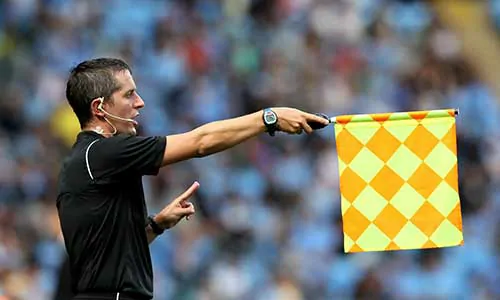
To fully appreciate the matches of the FIFA World Cup 2026, try to watch the assistant referee running along the touchline. They attempt to stay perfectly aligned with the second-last defender at all times. When an offside is called, notice how they hold their flag to indicate where on the field the offence happened:
- Flag pointed down: The offside offence occurred in the near third of the pitch (close to the linesman).
- Flag pointed straight out: The offside occurred in the middle third of the pitch.
- Flag pointed up: The offside occurred in the far third of the pitch (on the opposite side of the field).
In addition, pay attention to the body language of the players. Strikingly, modern forwards often look at the assistant referee immediately after taking a shot, proving that even the best players in the world are constantly thinking about Law 11.
11. Conclusion & Matchday Challenge
While the offside rule can seem daunting at first glance, breaking it down into basic conditions makes it highly accessible. It is the crucial rule that keeps football tactical, demanding absolute precision from the world’s finest athletes.
As we eagerly count down the days to the FIFA World Cup 2026, having a firm grasp of these rules will ensure you enjoy the games like a true expert. Now that you know the basics, the differences, and the exceptions, you are ready to analyze the matches with confidence.
What do you think?
Do you think semi-automated offside technology makes football fairer, or does it take away from the natural flow of the game? Share this guide with your friends and let us know your thoughts in the comments below!
12. Frequently Asked Questions (FAQ)
Q1: How does the offside rule apply to matches in the FIFA World Cup 2026?
Matches in the FIFA World Cup 2026 will follow the latest IFAB guidelines, meaning players are penalized if they gain an advantage, interfere with an opponent, or play the ball while in an offside position at the moment of the pass.
Q2: Can a player be offside during a throw-in?
No. There is absolutely no offside offence if a player receives the ball directly from a throw-in, making it a powerful tactical tool for long-throw specialists.
Q3: What is the punishment for an offside offence?
When an offside offence is called, the referee awards an indirect free kick to the opposing team from the exact spot where the offside player became actively involved in play.
Q4: Can you be offside in your own half?
No, a player must be fully in the opponent’s half of the field to be in an offside position. Starting a run in your own half is always legal.
Q5: Will semi-automated offside technology be used in the FIFA World Cup 2026?
Yes, advanced tracking technology is standard for the FIFA World Cup 2026 to reduce human error and make offside decisions quicker and highly accurate.
Q6: Does a deflection off a defender keep an attacker onside?
If a defender deliberately plays the ball (like trying to pass it back), the attacker is no longer offside. However, if the ball merely deflects off the defender accidentally, the attacker remains offside.