Most Goals in Football History: Official Rankings and Records
Most Goals in Football History: Official Rankings, Records, and the Path to the FIFA World Cup 2026
Goals are the ultimate currency in football. They define legacies, secure trophies, and immortalize names in sports history. As the global football community focuses its eyes on North America for the historic FIFA World Cup 2026, the debate over who has scored the most goals in football history has never been more intense.
In addition, this year’s tournament offers active legends a monumental stage to extend their tallies, making the FIFA World Cup 2026 a crucial turning point for all-time scoring records. Consequently, understanding the official rankings is vital to appreciate the history unfolding before our eyes.
Table of Contents
Defining “Official” Goals in Football History
Determining the exact number of goals scored by historical players is a complex task. Different statistical bodies, such as the Rec.Sport.Soccer Statistics Foundation (RSSSF) and the International Federation of Football History & Statistics (IFFHS), utilize slightly varying criteria.
For a goal to be deemed “official,” it must be scored in competitive senior matches for a club playing at a professional level, or for a senior national team. Friendly matches played by clubs, reserve team fixtures, and amateur-level games are generally excluded from official modern databases.
On the other hand, legendary players from previous eras often had their friendly and exhibition goals widely publicized. Looking ahead, the upcoming FIFA World Cup 2026 will library every goal using highly sophisticated digital tracking, leaving absolutely no room for future statistical ambiguity.
Top 10 Goalscorers in Football History (Official Rankings)
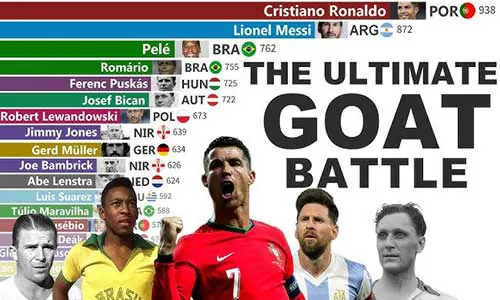
The following table outlines the top 10 highest goalscorers in the history of association football based on verified data compiled by IFFHS and RSSSF as of mid-2026:
| Rank | Player | Country | Verified Goals | Status |
|---|---|---|---|---|
| 1 | Cristiano Ronaldo | Portugal | 973 | Active |
| 2 | Lionel Messi | Argentina | 910 | Active |
| 3 | Josef Bican | Austria / Czechoslovakia | 805 | Retired |
| 4 | Pelé | Brazil | 762 | Retired |
| 5 | Romário | Brazil | 756 | Retired |
| 6 | Ferenc Puskás | Hungary / Spain | 725 | Retired |
| 7 | Robert Lewandowski | Poland | 685 | Active |
| 8 | Jimmy Jones | Northern Ireland | 639 | Retired |
| 9 | Gerd Müller | Germany | 634 | Retired |
| 10 | Joe Bambrick | Northern Ireland | 626 | Retired |
Detailed Profiles of the Top 5 Goalscorers
1. Cristiano Ronaldo – The Ultimate Goal Machine
Cristiano Ronaldo stands alone at the absolute peak of world football’s scoring charts. Having built an exceptional career across Sporting CP, Manchester United, Real Madrid, Juventus, and Al Nassr, he has maintained elite physical standards into his late thirties.
Ronaldo also holds the record for most international goals scored, alongside several prestigious European Golden Shoe awards. With Portugal’s squad locked in for the FIFA World Cup 2026, his journey to the historic four-digit mark remains a central storyline of the tournament.
2. Lionel Messi – The Creative Genius
Lionel Messi is widely considered one of the most complete footballers to ever play the game. His goalscoring efficiency is outstanding, backed by a legendary tenure at FC Barcelona, followed by spells at Paris Saint-Germain and Inter Miami.
In addition, Messi holds the record for the most goals scored for a single club, with 672 goals for Barcelona. His leadership of the Albiceleste during the FIFA World Cup 2026 represents a historic attempt to defend their global crown while climbing the all-time scoring charts.
3. Josef Bican – The Golden Era Icon
Active from the 1930s to the 1950s, Josef Bican was a force of nature for Slavia Prague and the Austrian and Czechoslovakian national teams. His clinical precision allowed him to maintain a goal-to-game ratio that has rarely been matched in the history of the sport.
While Bican’s records are safe in the history books, modern players looking towards the FIFA World Cup 2026 still draw inspiration from his legendary ability to find the back of the net. His official tally stands at a confirmed 805 goals.
4. Pelé – The King of Football
Pelé remains a foundational pillar of global football culture. A three-time World Cup champion, his career with Santos and the Brazilian national team produced some of the most memorable goals in the sport’s history.
Although his unofficial career count exceeds 1,200 goals, his verified competitive total stands at 762. Nevertheless, his impact on the World Cup’s global popularity paved the way for modern mega-events like the upcoming FIFA World Cup 2026.
5. Romário – The Penalty Box Master
Romário was known for his incredible acceleration, clinical finishing, and supreme confidence inside the penalty box. He guided Brazil to World Cup glory in 1994, scoring goals consistently in top leagues across the Netherlands, Spain, and Brazil.
Therefore, his verified tally of 756 goals firmly cements him in the top five. Romário’s legacy continues to serve as a blueprint for modern strikers aiming to make their mark on the international stage.
Active Legends and the FIFA World Cup 2026 Projection
The landscape of modern football is heavily influenced by the longevity of its current stars. As teams secure their qualifications for the FIFA World Cup 2026, strikers worldwide are pushing their physical boundaries to maintain high performance.
For players like Robert Lewandowski, the FIFA World Cup 2026 represents a major opportunity to cement their positions among the top ten goalscorers in history. Lewandowski’s clinical positioning makes him a primary threat in European football.
Many analysts are closely watching how the physical demands of the FIFA World Cup 2026 will affect these aging superstars. Consequently, the FIFA World Cup 2026 could serve as the final chapter in their legendary international careers, leaving fans eager to witness every match.
How the FIFA World Cup 2026 Could Redefine the Top Spot
If Cristiano Ronaldo maintains his efficiency during the FIFA World Cup 2026, he may well push his tally closer to the unreachable 1,000-goal milestone. This would set a record that could stand for decades to come.
On the other hand, Lionel Messi’s creative role in the Argentina squad at the FIFA World Cup 2026 could yield enough goals to narrow the gap dramatically. Therefore, every single minute played during the FIFA World Cup 2026 carries immense historical weight for the global scoring hierarchy.
Furthermore, the expanded format of the FIFA World Cup 2026 means more matches will be played than in any previous edition. The global audience for the FIFA World Cup 2026 will witness unique tactical battles that directly influence these historic personal records.
Historic World Cup Goalscorers and Their Legacy Ahead of the FIFA World Cup 2026
Before the first whistle blows at the FIFA World Cup 2026, it is essential to appreciate the historic figures who defined World Cup scoring. These players might not top the overall career charts, but their tournament-specific records remain legendary.
While Miroslav Klose remains the ultimate World Cup goalscorer with 16 goals, modern contenders at the FIFA World Cup 2026 are eager to challenge his reign. Players like Kylian Mbappé are already climbing this specific list at a rapid pace.
In addition, legendary figures such as Just Fontaine (who scored 13 goals in a single tournament) and Gerd Müller represent the pinnacle of World Cup efficiency. The standard they set will be the benchmark for every forward participating in the FIFA World Cup 2026.
Why Goal Verification Remains a Major Challenge
The main reason for disputes in all-time rankings is the poor record-keeping of the early 20th century. Many regional leagues, wartime tournaments, and unofficial international friendlies were recorded poorly or not at all.
For example, Pelé and Josef Bican both claimed to have scored well over 1,000 goals during their careers. However, modern statistical bodies like IFFHS do not count goals scored in reserve matches or non-competitive club exhibitions.
This issue will again be under the microscope during the FIFA World Cup 2026, as statisticians trace every single goal with modern optical tracking and real-time data systems to ensure perfect historical consistency.
Frequently Asked Questions (FAQ)
Q: Will Cristiano Ronaldo play in the FIFA World Cup 2026?
A: Yes, Cristiano Ronaldo is expected to lead Portugal at the FIFA World Cup 2026, pursuing further goalscoring records.
Q: Can Lionel Messi break the all-time goalscoring record at the FIFA World Cup 2026?
A: While breaking the absolute career record during the tournament is mathematically difficult, Lionel Messi can significantly close the gap on Cristiano Ronaldo at the FIFA World Cup 2026.
Q: Who has scored the most goals in a single FIFA World Cup tournament?
A: Just Fontaine of France holds the record, having scored 13 goals in the 1958 tournament.
Q: Why are Pelé’s 1,281 goals not fully recognized as official?
A: Over 500 of Pelé’s goals were scored in friendly matches, tour exhibitions, and military games, which do not meet the criteria for official senior competitive matches.
Q: Who is the highest-scoring defender in football history?
A: Ronald Koeman holds the record for the most goals scored by a defender, with over 250 official career goals.
Conclusion and Final Thoughts
The race to score the most goals in football history has reached an unprecedented level of competition. Modern training methods, coupled with longer playing careers, have allowed today’s superstars to challenge records that once seemed completely out of reach.
As we prepare to enjoy the spectacles of the FIFA World Cup 2026, we are privileged to witness a golden era of legendary goalscorers. Whether you support Portugal, Argentina, or simply love the beautiful game, the history written on the pitch during the FIFA World Cup 2026 will live on for generations.
Do you believe the goal records will be rewritten at the FIFA World Cup 2026? Let us know your thoughts in the comments below, and don’t forget to check out our analysis on tactical formations in modern football and the next generation of goalscorers!