FIFA World Cup 2026 Schedule: Match Dates, Groups and Kick-Off Times
FIFA World Cup 2026 Schedule: Match Dates, Groups, and Kick-Off Times
The wait is finally over for football fans worldwide. The highly anticipated FIFA World Cup 2026 is just days away from its historic kickoff. Spanning three host nations—the United States, Canada, and Mexico—this tournament marks the largest and most ambitious edition of the world’s premier football event. With an expanded roster of teams and more matches than ever before, keeping track of when and where your favorite nations play is essential for every football enthusiast.
In this comprehensive guide, we provide a detailed breakdown of the complete tournament schedule, the newly formatted groups, and the key kick-off times across multiple time zones. Whether you are planning your viewing schedule from home or traveling to one of the 16 host cities, this resource will keep you informed throughout the 39 action-packed days of elite international football.
Table of Contents
- The Historic Expansion of the FIFA World Cup 2026
- FIFA World Cup 2026 Groups: The Complete List
- Group-by-Group Preview and Key Matchups
- Full FIFA World Cup 2026 Schedule and Match Dates
- Stadiums and Kick-Off Times for the FIFA World Cup 2026
- Suggested Resources and Guides
- Conclusion and Next Steps
- Frequently Asked Questions (FAQ)
The Historic Expansion of the FIFA World Cup 2026
The FIFA World Cup 2026 represents a landmark shift in the history of international sports. Moving away from the traditional 32-team format that has been in place since 1998, this edition features an expanded lineup of 48 teams. Consequently, the tournament will host a record-breaking 104 matches, offering fans more action, more goals, and more dramatic storylines to follow.
To accommodate this expansion, the tournament is jointly hosted by the United States, Mexico, and Canada. This co-hosting model is the first of its kind to feature three nations, spreading the matches across major metropolitan hubs from Vancouver to Mexico City. The matches will be played in iconic stadiums, many of which are home to premier American football and soccer clubs.
Furthermore, the progression structure has undergone a significant transformation. Rather than just the top two teams from each group advancing, the new format introduces a Round of 32 knockout stage. This means that the top two teams from all twelve groups, alongside the eight best third-place finishers, will keep their championship dreams alive. As a result, the final matchdays of the group stage will offer intense competition, as teams battle for every single point and goal.
FIFA World Cup 2026 Groups: The Complete List
The draw for the FIFA World Cup 2026 has distributed the 48 qualified nations into 12 distinct groups of four, designated from Group A to Group L. This arrangement guarantees that every participating nation will play a minimum of three group stage matches, establishing a level playing field for both seasoned giants and ambitious debutants.
Below is the finalized group configuration as confirmed by FIFA. The three co-host nations—Mexico, Canada, and the United States—have been placed in Groups A, B, and D respectively to anchor their home-soil campaigns.
| Group | Teams |
|---|---|
| Group A | Mexico, South Africa, Korea Republic, Czechia |
| Group B | Canada, Switzerland, Qatar, Bosnia & Herzegovina |
| Group C | Brazil, Morocco, Scotland, Haiti |
| Group D | USA, Australia, Paraguay, Türkiye |
| Group E | Germany, Ecuador, Côte d’Ivoire, Curaçao |
| Group F | Netherlands, Japan, Tunisia, Sweden |
| Group G | Belgium, Iran, Egypt, New Zealand |
| Group H | Spain, Uruguay, Saudi Arabia, Cabo Verde |
| Group I | France, Senegal, Norway, Iraq |
| Group J | Argentina, Austria, Algeria, Jordan |
| Group K | Portugal, Colombia, Uzbekistan, DR Congo |
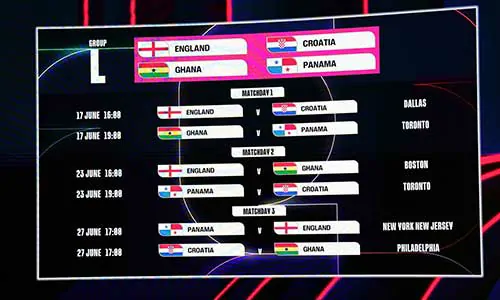
| Group L | England, Croatia, Panama, Ghana |
Group-by-Group Preview and Key Matchups
With 48 nations competing, the tactical diversity in the group stages is higher than in any previous edition. Here is an in-depth look at what to expect from each of the 12 groups during the opening weeks of the tournament.
Group A: Co-Hosts Open the Show
Mexico headlines Group A and enjoys the advantage of starting their campaign on home soil. Their opening fixture against South Africa at the historic Estadio Azteca will set the tone for the entire tournament. Meanwhile, Korea Republic’s tactical discipline and Czechia’s physical defensive style mean that securing an automatic qualification spot will be highly contested.
Group B: Canada’s Big Opportunity
Canada hosts World Cup matches for the first time in their history. In Group B, they face a balanced pool of opponents. Switzerland brings tournament-hardened European pedigree, while Qatar’s technical squad and Bosnia & Herzegovina’s physical approach will challenge the co-hosts at every turn. Consequently, this is a highly unpredictable group where any nation can progress.
Group C: The Clash of Giants
Group C features an incredibly exciting matchup between Brazil and Morocco. Brazil enters the tournament with high expectations, but they will face a formidable Moroccan squad that proved its world-class potential in recent years. In addition, Scotland’s passionate squad and debutants Haiti will look to cause major upsets against these two pre-tournament favorites.
Group D: USMNT Leads a Competitive Field
The United States Men’s National Team (USMNT) anchors Group D, playing their group fixtures in front of energetic home crowds. However, their path to the knockout rounds is far from simple. Australia’s relentless work ethic, Paraguay’s robust South American defensive unit, and Türkiye’s highly skilled and passionate squad will make every match in this group highly competitive.
Group E: European Power and African Ambition
Germany aims to reassert themselves on the world stage in Group E, but they face a challenging draw. Côte d’Ivoire brings physical dominance and tactical depth, while Ecuador’s fast transition play is difficult to defend. On the other hand, debutants Curaçao will look to play with absolute freedom, presenting a potential trap for any team that underestimates them.
Group F: Tactical Intrigues
The Netherlands and Japan highlight Group F in what promises to be a masterclass in contrasting styles. The Dutch team’s possession-based approach will go head-to-head with Japan’s lightning-fast transitional play. Furthermore, Sweden’s physical aerial presence and Tunisia’s organized defensive structure ensure that Group F will be decided by the narrowest of margins.
Group G: Balanced Competitors
Belgium enters a transitional phase with an exciting mix of young talents and experienced leaders. In Group G, they will be tested by Egypt, whose creative attacking threat is capable of breaking down any defense. Meanwhile, Iran’s defensive resilience and New Zealand’s structured style of play mean that points will be difficult to secure in this pool.
Group H: Iberian Flare and South American Grit
Spain’s passing philosophy will be tested by Uruguay’s legendary defensive grit in a highly anticipated Group H fixture. In addition, Saudi Arabia’s tactical familiarity under pressure and Cabo Verde’s debut enthusiasm make this group highly watchable. Securing the top spot will be critical to avoiding the heavyweights in the Round of 32.
Group I: French Dominance Tested
France remains one of the primary favorites to lift the trophy, but their Group I campaign features several challenging fixtures. Senegal’s organized and athletic squad presents a major threat, while Norway’s clinical attacking force can punish any defensive mistake. Iraq, returning to the global stage, completes this competitive lineup.
Group J: Champions Begin the Defense
Defending champions Argentina, likely led by Lionel Messi in his final historic appearance, begin their journey in Group J. They will face a disciplined Austrian squad and a physical Algerian team, both fighting closely for the second automatic qualification spot. Debutants Jordan will look to make their mark on history in this competitive environment.
Group K: High-Octane Action
Portugal brings an exceptionally deep squad of creative talents to Group K. They will face Colombia, a team renowned for its passionate playing style and rapid counter-attacks. Uzbekistan, making their debut World Cup appearance, and a physical DR Congo team complete a group that promises high-scoring and entertaining fixtures.
Group L: Traditional Rivals Meet Again
England faces Croatia in Group L, renewing a classic European international rivalry that has produced incredible drama in past tournaments. Ghana’s youthful, athletic squad possesses the quality to beat any side on their day, while Panama’s defensive organization will look to frustrate the group favorites.
Full FIFA World Cup 2026 Schedule and Match Dates
The tournament schedule is structured to minimize travel fatigue for teams while maximizing the viewing experience for fans worldwide. The matches are organized into regional clusters to reduce the distance teams must travel during the group stage.
The action kicks off on June 11, 2026, and concludes on July 19, 2026. Below is the official progression timeline of the tournament, illustrating how the 48 teams will be narrowed down to the final two competitors.
| Tournament Stage | Start Date | End Date | Number of Matches |
|---|---|---|---|
| Group Stage | June 11, 2026 | June 27, 2026 | 72 Matches |
| Round of 32 | June 28, 2026 | July 3, 2026 | 16 Matches |
| Round of 16 | July 4, 2026 | July 7, 2026 | 8 Matches |
| Quarter-Finals | July 9, 2026 | July 11, 2026 | 4 Matches |
| Semi-Finals | July 14, 2026 | July 15, 2026 | 2 Matches |
| Third Place Play-off | July 18, 2026 | July 18, 2026 | 1 Match |
| The Final | July 19, 2026 | July 19, 2026 | 1 Match |
Consequently, the tournament features a highly condensed schedule with multiple matches played daily during the group stage. This packed schedule ensures that fans are treated to a continuous festival of football throughout June and July.
Stadiums and Kick-Off Times for the FIFA World Cup 2026
Time Zone Management and Kick-Off Times Explained
With matches played across three countries, managing different time zones is one of the most unique aspects of the FIFA World Cup 2026. The host cities span four major time zones: Pacific Time (PT), Mountain Time (MT), Central Time (CT), and Eastern Time (ET).
Therefore, kick-off times will vary significantly depending on where the match is hosted. For instance, a match scheduled for 3:00 PM local time in Los Angeles (PT) will air at 6:00 PM in New York (ET). This requires fans from Europe, South America, Asia, and Africa to monitor the local stadium time zones carefully to avoid missing key fixtures.
To help you prepare, below is the list of the 16 official host venues categorized by country, showing where the matches of the FIFA World Cup 2026 will take place:
- United States:
- MetLife Stadium (New York/New Jersey) – Host of the Final Match
- SoFi Stadium (Los Angeles)
- AT&T Stadium (Dallas) – Host of a Semi-Final Match
- Mercedes-Benz Stadium (Atlanta) – Host of a Semi-Final Match
- Hard Rock Stadium (Miami) – Host of the Third Place Play-off
- Gillette Stadium (Boston)
- Lincoln Financial Field (Philadelphia)
- GEHA Field at Arrowhead Stadium (Kansas City)
- NRG Stadium (Houston)
- Lumen Field (Seattle)
- Levi’s Stadium (San Francisco Bay Area)
- Mexico:
- Estadio Azteca (Mexico City) – Host of the Opening Match
- Estadio Akron (Guadalajara)
- Estadio BBVA (Monterrey)
- Canada:
- BC Place (Vancouver)
- BMO Field (Toronto)
Meanwhile, broadcast windows are designed to accommodate primetime viewing in North America while remaining as accessible as possible for international audiences in Europe, South America, and West Africa. Kickoff slots are generally scheduled for early afternoon, late afternoon, and evening local times.
Suggested Resources and Guides
To enhance your tournament experience, we recommend checking out additional resources. These guides offer deeper insights into tactical analyses, live viewing options, and venue logistics:
-
- Explore our expert World Cup predictions and favorite teams to see which nations are expected to go deep into the tournament.
- Check out our comprehensive guide on how to watch the matches live from any country without interruptions.
- Plan your matchday travel with our detailed World Cup stadiums and host cities guide.
- Visit the official official FIFA website for ticket updates, live standings, and official announcements.
- Follow real-time news and team updates on Sky Sports Football.
Conclusion and Next Steps
The FIFA World Cup 2026 is set to be a historic celebration of football. With 48 teams, 104 matches, and 16 iconic host venues, this tournament promises unforgettable drama and world-class skill. From the opening whistle at the Estadio Azteca on June 11 to the final crowning moment at MetLife Stadium on July 19, fans are in for an incredible ride.
Make sure you bookmark this page to keep the match dates and group structures close at hand as the action unfolds. Who do you think will lift the trophy this summer? Share your tournament predictions in the comments below, and don’t forget to share this guide with your fellow football fans!
Frequently Asked Questions (FAQ)
When does the FIFA World Cup 2026 start and end?
The tournament officially kicks off with the opening match on Thursday, June 11, 2026, and concludes with the final match on Sunday, July 19, 2026.
Which stadium will host the FIFA World Cup 2026 final?
The final match of the tournament will be played at MetLife Stadium located in East Rutherford, New Jersey (New York/New Jersey area), on July 19, 2026.
How many teams are participating in the tournament?
For the first time in history, the tournament has expanded to feature 48 national teams, up from the traditional 32-team format used in previous editions.
How do teams qualify for the knockout stage under the new format?
The top two teams from each of the 12 groups, along with the eight best third-place finishers across all groups, will qualify for the newly introduced Round of 32 knockout stage.
Which countries are co-hosting the tournament?
The tournament is co-hosted by three North American nations: the United States, Canada, and Mexico. Matches will be played across 16 different host cities.
Are there any debutant teams in the FIFA World Cup 2026?
Yes, four nations are making their historic debut appearances in this tournament: Cabo Verde, Curaçao, Jordan, and Uzbekistan.